

GLP-1 Support·Side effects in women
Side effect guide
Some GLP-1 side effects really are more common in women — and the labels say which.
Most articles quote one blended number. The FDA-approved labels break several side effects out by sex, and the gaps are large. Here is what they show.
Updated September 2026
Start here
Why a women-specific page is not a marketing angle
The trials these medications were approved on were majority women. In the 68-week Wegovy obesity trials, 71% of participants were female; in the 7.2 mg arm, 70%; in Study 7, 76%. So the headline numbers you read are already, mostly, numbers about women.
What is less well known is that for a few specific side effects the labels publish the split. Where they do, the difference between women and men is not subtle.
This page covers what the current US prescribing information states — the same source your prescriber is working from. How it applies to you is a conversation with them.
The clearest split
Hair loss: several times more common in women
Both weight-management labels that publish a sex breakdown show the same pattern, and it is a wide one.
| Label | Women | Men | Placebo |
|---|---|---|---|
| Wegovy 2.4 mg | 4% | 0.9% | 1% overall (2% women, 0 men) |
| Wegovy 7.2 mg | 8.4% | 0.2% | 1.0% overall (1.5% women, 0 men) |
| Zepbound (pooled) | 7.1% | 0.5% | 1.3% women, 0% men |
| Foundayo (orforglipron) | reported at 4–5% overall | — | 2% |
Both labels also state the reason in their own words: hair-loss adverse reactions “were associated with weight reduction.” That is the manufacturers describing shedding that follows rapid weight loss, rather than damage to the follicle.
Zepbound's label adds a detail worth holding on to: across its two pooled studies, no patient taking the medication stopped treatment because of hair loss. One patient on placebo did.
Bone health
Fractures: a signal that appears in women specifically
In the Wegovy cardiovascular outcomes trial, hip and pelvis fractures were reported more often on the medication than on placebo in female patients — 1% (24 of 2,448) against 0.2% (5 of 2,424). In patients aged 75 and over, the figures were 2.4% (17 of 703) against 0.6% (4 of 663).
This is one to raise with your own clinician if you are postmenopausal, have a history of low bone density, or are losing weight quickly. Adequate protein, resistance training and your clinician's view on calcium and vitamin D status are the levers that exist here.
What the labels do not split
Where the honest answer is that the data is pooled
Nausea, vomiting, constipation and diarrhea are the most common adverse reactions on every GLP-1 label, and they are reported for the whole trial population rather than by sex. Wegovy 2.4 mg reported nausea in 44% of adults against 16% on placebo; Zepbound reported 25%, 29% and 28% at 5, 10 and 15 mg against 8% on placebo.
Because those trial populations were roughly 70–76% women, those numbers already describe women's experience more than men's. What no published label gives is a clean women-versus-men comparison for the GI effects, so anyone quoting one is estimating.
Cycle, contraception and pregnancy
These are prescriber questions, and they are specific to your medication and history. The labels carry dedicated sections on use in pregnancy and on interactions with oral medications, and your prescriber and pharmacist are the people who can apply them to you.
Where GLPrelief fits
Daily support around the parts you can influence
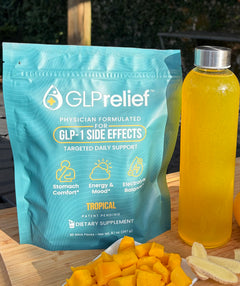
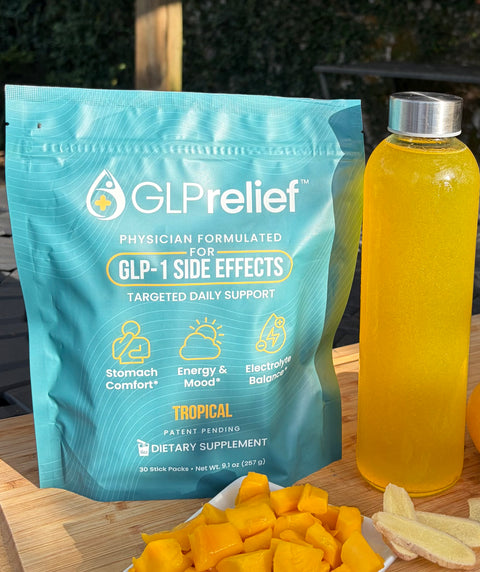
The levers that exist here are eating enough — protein especially — staying ahead on fluid and electrolytes, and keeping your routine steady on the days appetite is low. GLPrelief was built for that daily job.
- Daily electrolyte support with sodium, potassium and chloride, in 16–20 oz of cold water — support for hydration on days when eating and drinking both drop off
- Six B vitamins, with B2, B6 and B12 in coenzyme forms, that support cellular energy metabolism
- Magnesium and potassium, which support normal muscle function
- Ginger root extract and gentle soluble fiber that support digestive comfort and regularity
Fifteen physician-selected ingredients in one tropical-flavored stick. No caffeine, no artificial colors or dyes, sweetened with allulose and sucralose. Every ingredient is on the label.
Common questions
GLP-1 side effects in women
Are Ozempic side effects different in women?
For most side effects the labels report one pooled number rather than a split by sex, so there is no published women-versus-men comparison for nausea, vomiting or constipation. Where the labels do break it out, the differences are large: hair loss was reported in 4% of women against 0.9% of men on Wegovy 2.4 mg, and 7.1% of women against 0.5% of men on Zepbound. Note also that the obesity trials were 70 to 76% female, so the headline rates already describe mostly women.
Why is hair loss so much more common in women on a GLP-1?
The labels do not explain the gap, and the same gap appears in the placebo groups — 2% of women against no men on placebo in one Wegovy pool — which suggests it reflects how shedding presents and gets noticed rather than something specific to the medication. Both Wegovy and Zepbound state that hair-loss reactions were associated with weight reduction.
Do GLP-1 medications affect bone health in women?
In the Wegovy cardiovascular outcomes trial, hip and pelvis fractures were reported in 1% of female patients on the medication against 0.2% on placebo, and in 2.4% of patients aged 75 and older against 0.6%. That is a signal worth raising with your own clinician, particularly if you are postmenopausal or losing weight quickly.
Which GLP-1 has the fewest side effects for women?
No label supports ranking the medications that way, and the trials were not designed to compare them head to head in women. The choice belongs to you and your prescriber, and it turns on your medical history, what you are treating and how you tolerate the dose escalation.
Does GLPrelief help with side effects that affect women more?
GLPrelief's role is the daily nutritional support around your prescription: daily electrolyte support and hydration, active-form B vitamins that support cellular energy metabolism, magnesium and potassium that support normal muscle function, and ginger and gentle soluble fiber that support digestive comfort and regularity. It is formulated for the daily routine alongside your prescription.
Related reading
- Hair loss on a GLP-1
- Muscle loss on a GLP-1
- Long-term side effects: what the evidence covers
- When to call your doctor
Incidence figures on this page are from the current US prescribing information for Wegovy (semaglutide), Zepbound (tirzepatide), Ozempic (semaglutide), Rybelsus and Ozempic tablets (oral semaglutide) and Foundayo (orforglipron), retrieved from DailyMed on 4 September 2026.
*These statements have not been evaluated by the Food and Drug Administration. This product is not intended to diagnose, treat, cure, or prevent any disease. If side effects feel severe, persistent or worrying, talk to your healthcare provider. This page is educational and does not replace advice from your own clinician.
Ozempic®, Wegovy®, Rybelsus®, Mounjaro®, Zepbound® and Foundayo™ are registered trademarks of their respective owners. GLPrelief is not affiliated with, sponsored by, or endorsed by Novo Nordisk or Eli Lilly.
Formulated by George W. Carroll, MD — Physician Formulator, GLPrelief.