

GLP-1 Support·Long-term side effects
Side effect guide
“Long-term” on a GLP-1 currently means about three to four years of controlled data.
The honest answer to what happens over years is: here is exactly how far the controlled evidence runs, and here is what it found inside that window.
Updated September 2026
The size of the window
How long the longest trials actually ran
Two datasets set the outer edge of what is known from randomised, placebo-controlled research.
| Dataset | Length | Size |
|---|---|---|
| Wegovy cardiovascular outcomes trial | median follow-up 41.8 months (about 3.5 years) | 96.9% of patients completed; vital status available for 99.4% |
| Oral semaglutide cardiovascular outcomes trial (Trial 7) | 4 years | 4,825 patients randomised to semaglutide tablets |
| The obesity weight-management trials | 68 weeks, plus a 7-week off-drug follow-up | the trials most weight-loss figures come from |
So when an article says “long-term,” what exists behind it is roughly a three-to-four-year controlled window in adults, plus accumulating postmarketing reports. Anything said about ten or twenty years is extrapolation, whoever is saying it.
In the Wegovy outcomes trial, 31% of patients on the medication and 27% of patients on placebo permanently discontinued study drug. Of those still on treatment at one year, 76% were on the 2.4 mg dose.
Inside the window
What the long trials found
Gallbladder events
In the four-year oral semaglutide trial, cholelithiasis — gallstones — was reported in 1.1% of patients on the medication against 0.9% on placebo, and cholecystitis in 1.1% against 0.7%. Both labels instruct clinicians to investigate if either is suspected.
Kidney function
In Zepbound's two pooled studies, acute kidney injury was reported in 0.5% of treated patients against 0.2% on placebo. The labels are explicit that the majority of these events occurred in patients who had gastrointestinal reactions leading to dehydration. That makes fluid intake during vomiting or diarrhea a practical matter.
Hair loss
Reported in 3.3% of adults on Wegovy 2.4 mg against 1% on placebo, and in 5% at the higher tirzepatide doses against 1%. Both labels state these reactions were associated with weight reduction.
Bone
In the cardiovascular outcomes trial, hip and pelvis fractures were reported in 1% of female patients on the medication against 0.2% on placebo, and in 2.4% of patients aged 75 and older against 0.6%.
The pattern over time
Most gastrointestinal effects cluster early
The Ozempic label puts it plainly: “The majority of reports of nausea, vomiting, and/or diarrhea occurred during dose escalation.” Zepbound's label says the same — those events occurred during escalation and decreased over time.
That is the single most useful thing to know about the shape of this over years: the hardest stretch for most people is the climb, and each dose step is at least four weeks apart by design, precisely to reduce those reactions.
Discontinuation because of gastrointestinal reactions is measured too. On Ozempic, 3.1% at 0.5 mg and 3.8% at 1 mg stopped for that reason. On the oral orforglipron tablet, 3% to 6% depending on dose, against 0.7% on placebo.
What to watch
The symptoms worth a call, at any point
These are on every label and they do not become less important the longer you have been taking the medication:
- Severe abdominal pain, sometimes spreading to the back, with or without vomiting — the labels flag this for pancreatitis
- Pain in the upper right abdomen, fever, yellowing of the skin or eyes, or clay-colored stools — gallbladder
- Vomiting or diarrhea that will not settle, which is the route to dehydration and kidney problems
- Swelling of the face, lips or tongue, or trouble breathing — urgent
- Changes in vision, if you have type 2 diabetes
Tell every clinician you are on a GLP-1 before any surgery or procedure involving anesthesia or deep sedation. That instruction is on all four injectable labels.
Where GLPrelief fits
The daily habits that hold over years
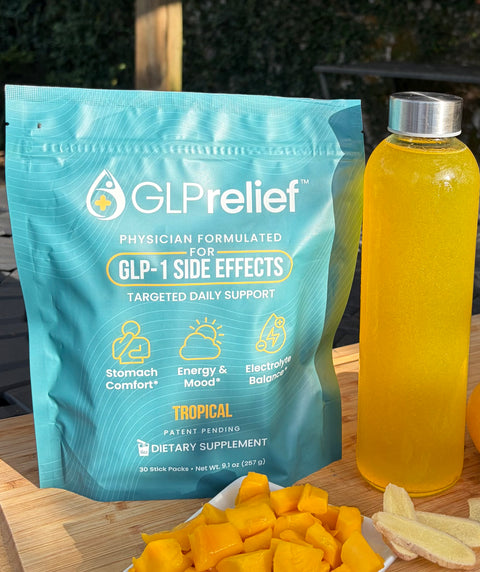
What a daily routine can do is make the parts you control easier to keep up over years: fluid and electrolytes, enough protein, and steady digestion on the days appetite is low.
- Daily electrolyte support — sodium, potassium and chloride in 16–20 oz of cold water, supporting hydration
- Ginger root extract and gentle soluble fiber, supporting digestive comfort and regularity
- Magnesium and potassium, supporting normal muscle function
- Six B vitamins, with B2, B6 and B12 in coenzyme forms, supporting cellular energy metabolism
One tropical-flavored stick a day, fifteen physician-selected ingredients. Every ingredient is on the label.
Common questions
Long-term GLP-1 questions
What are the long-term side effects of GLP-1 medications?
Within the roughly three-to-four-year controlled window that exists, the effects the labels quantify are gallbladder events (cholelithiasis 1.1% against 0.9% on placebo in the four-year oral semaglutide trial), acute kidney injury (0.5% against 0.2% in Zepbound's pooled studies, mostly following dehydration from gastrointestinal reactions), hair loss (3.3% against 1% on Wegovy 2.4 mg), and in the cardiovascular outcomes trial more hip and pelvis fractures in female patients (1% against 0.2%).
How many years of safety data are there on GLP-1 medications?
The longest randomised, placebo-controlled datasets are the Wegovy cardiovascular outcomes trial, with a median follow-up of 41.8 months, and a four-year cardiovascular outcomes trial of oral semaglutide tablets in 4,825 patients. The weight-management trials most commonly quoted ran 68 weeks. Longer horizons rest on postmarketing reporting.
Do GLP-1 side effects get better or worse over time?
For the gastrointestinal effects, the labels state that the majority of nausea, vomiting and diarrhea occurred during dose escalation and decreased over time. That is why every label spaces dose increases at least four weeks apart.
Is it safe to stay on a GLP-1 for years?
That is a question for your prescriber, who is weighing your own history against what the label says. What the evidence supports is a description of what was observed over about three to four years in large controlled trials, which is set out above.
Should I take a supplement long term alongside a GLP-1?
Ask your prescriber, particularly about anything that could interact with your medication. GLPrelief was formulated as the daily nutritional support around a GLP-1 routine: daily electrolyte support and hydration, ginger and gentle soluble fiber for digestive comfort and regularity, magnesium and potassium supporting normal muscle function, and active-form B vitamins supporting cellular energy metabolism.
Related reading
Incidence figures on this page are from the current US prescribing information for Wegovy (semaglutide), Zepbound (tirzepatide), Ozempic (semaglutide), Rybelsus and Ozempic tablets (oral semaglutide) and Foundayo (orforglipron), retrieved from DailyMed on 4 September 2026.
*These statements have not been evaluated by the Food and Drug Administration. This product is not intended to diagnose, treat, cure, or prevent any disease. If side effects feel severe, persistent or worrying, talk to your healthcare provider. This page is educational and does not replace advice from your own clinician.
Ozempic®, Wegovy®, Rybelsus®, Mounjaro®, Zepbound® and Foundayo™ are registered trademarks of their respective owners. GLPrelief is not affiliated with, sponsored by, or endorsed by Novo Nordisk or Eli Lilly.
Formulated by George W. Carroll, MD — Physician Formulator, GLPrelief.