


GLP-1 Support
Hair loss on a GLP‑1 is real, and it is mostly about the weight, not the drug.
- Nausea on a GLP-1
- Why side effects happen
- What to expect, week by week
- Formulated by George W. Carroll, MD · 45 years in medical weight loss
GLP-1 Support·Hair loss
Side effect guide
Hair loss on a GLP-1 is real, and it is mostly about the weight, not the drug.
It is one of the least-discussed side effects and one of the most distressing. Here is how common it actually is, what the labels say is causing it, and what tends to help.
Updated September 2026
The numbers
Between 3% and 7% of people report it — and it lands overwhelmingly on women.
Hair loss appears in the adverse-reaction tables of the weight-management labels, not the diabetes ones. In Wegovy's trials it was reported by 3.3% of adults on the 2.4 mg dose against 1% on placebo. In Zepbound's trials it was 7.1% of women against 0.5% of men, with 1.3% of women on placebo.
The split by sex is the part nobody mentions. On Wegovy 2.4 mg it was 4% of women and 0.9% of men. At the higher 7.2 mg dose it rose to 5.8% overall — 8.4% of women, and 0.2% of men.
On Ozempic specifically: the label lists alopecia under postmarketing experience, so it has been reported but carries no trial incidence rate. The measured numbers above come from the same molecules at weight-management doses, which is the closest published guide there is.
Why it happens
The labels tie it to the weight coming off, not to the medication acting on hair.
Both manufacturers say the same thing in their FDA-approved labeling: hair loss adverse reactions in treated patients were associated with weight reduction. That is a meaningful distinction. It is the same shedding that follows childbirth, surgery, serious illness and crash dieting — a physiological stress pushes an unusually large share of follicles out of their growing phase at once, and the shedding turns up later, once those hairs let go together.
Two things follow from that. It tends to track how fast the weight is coming off rather than which drug you are on. And because it is a shift in timing rather than damage to the follicle, hair that sheds this way is generally hair the follicle can grow again — though how and when is a question for your own clinician, not a page.
Eating far less is part of the same story
Hair is protein, and it is metabolically expensive. When appetite drops hard and total intake falls with it, hair is not the body's first priority. That is the practical connection between appetite suppression and what shows up in the shower drain two months later.
What tends to help
The levers are intake, time, and being gentle with what you have.
Eat enough, and get protein in first
This is the one that matters most and the one that gets hard when nothing sounds good. Protein at every eating occasion, even when the portion is small, is the same advice that protects lean mass — and it is working on the same problem.
Give it time at a steady weight
Because the shedding is tied to the pace of loss, it commonly settles as the pace does. That is cold comfort in month three, but it is the pattern.
Be kind to the hair you have
Less heat, less tension, gentler handling. None of this changes what is happening at the follicle, but it stops you losing hair to breakage on top of shedding.
Worth a call to your clinician: shedding that is patchy rather than diffuse, a scalp that is red, scaly or itchy, or hair loss arriving with fatigue, cycle changes or feeling cold. Thyroid and iron are ordinary things to check, and they are checkable.
Where GLPrelief fits
Where GLPrelief fits into your day.
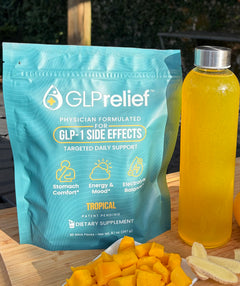
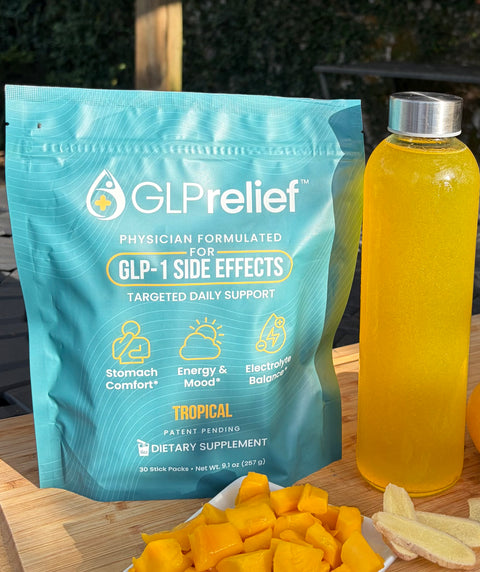
Eating enough — protein especially — is the foundation here, and it is exactly what gets difficult when your appetite is gone. GLPrelief covers the daily support around that: the part that quietly slips when you are eating a third of what you used to.
- Active-form B vitamins — support cellular energy metabolism.
- Sodium, potassium and magnesium — daily electrolyte support, so the water you drink actually lands.
- Ginger and gentle soluble fiber — support stomach comfort and regularity, which matters on the days eating is a chore.
Fifteen physician-selected ingredients in one stick: electrolytes, six B vitamins, four botanicals and fiber. Vegan, non-GMO, no caffeine, sweetened with allulose and sucralose. Blended and packed in Lindon, Utah, in an FDA-registered, cGMP-certified facility.
Common questions
What people ask about hair loss on a GLP-1.
Does Ozempic cause hair loss?
Ozempic's label lists alopecia under postmarketing experience, which means it has been reported but does not carry a trial incidence rate. The measured numbers come from the weight-management labels for the same molecules: hair loss was reported in 3.3% of adults on Wegovy 2.4 mg against 1% on placebo, and Zepbound reported 7.1% in women against 1.3% on placebo.
How common is hair loss on Wegovy or Zepbound?
In Wegovy's trials, 3.3% of adults on the 2.4 mg dose reported it (4% of women, 0.9% of men) against 1% on placebo. At the 7.2 mg dose it was 5.8% (8.4% of women). In Zepbound's trials it was 7.1% of women and 0.5% of men, against 1.3% of women on placebo.
Why does it affect women so much more than men?
The labels do not explain the difference, but they record it consistently: 4% of women against 0.9% of men on Wegovy 2.4 mg, and 7.1% against 0.5% on Zepbound. The same gap appears in the placebo groups, which suggests it reflects how shedding presents and is noticed rather than something specific to the medication.
Is it the medication itself, or the weight loss?
Both the Wegovy and Zepbound labels say the same thing: hair loss adverse reactions in treated patients were associated with weight reduction. That is the manufacturers' own reading in the FDA-approved labeling — it tracks how fast and how much weight comes off, which is why it also shows up after surgery, illness and crash dieting.
Should I stop my medication over it?
That is your prescriber's call, not a decision to make alone. Worth knowing: in Zepbound's trials no treated patient discontinued because of hair loss, while one placebo-treated patient did. Bring it to the clinician who prescribed your medication, particularly if shedding is patchy, comes with a rash or scaling, or arrives alongside fatigue or cycle changes.
Does GLPrelief help with hair loss?
The levers here are eating enough — protein especially — and giving your body time at a steady weight. If shedding is patchy or comes with other symptoms, that is a conversation with your clinician. GLPrelief's role is the daily nutritional support around that: active-form B vitamins that support cellular energy metabolism, daily electrolyte support, and ginger and gentle soluble fiber that support digestive comfort on the days eating is hard.
Related reading
- Muscle loss on a GLP-1
- What to expect in your first month
- Eating well on a GLP-1
- When to call your doctor
Incidence figures are from the current US prescribing information for Wegovy (semaglutide), Zepbound (tirzepatide) and Ozempic (semaglutide), retrieved from DailyMed on 4 September 2026.
*These statements have not been evaluated by the Food and Drug Administration. This product is not intended to diagnose, treat, cure, or prevent any disease. If side effects feel severe, persistent or worrying, talk to your healthcare provider. This page is educational and does not replace advice from your own clinician.
Ozempic®, Wegovy®, Mounjaro® and Zepbound® are registered trademarks of their respective owners. GLPrelief is not affiliated with, sponsored by, or endorsed by Novo Nordisk or Eli Lilly.
Formulated by George W. Carroll, MD — Physician Formulator, GLPrelief.