


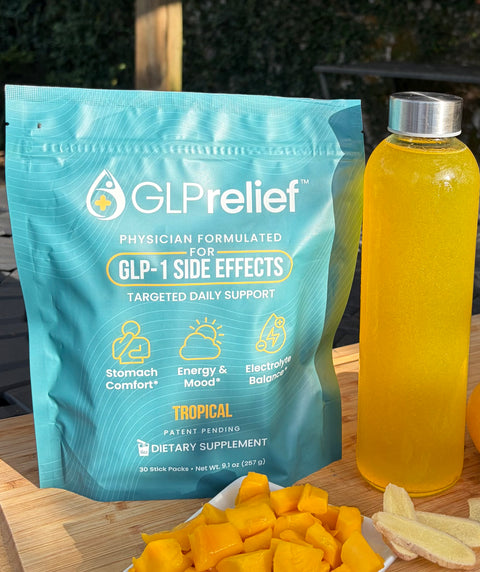
Article: How to Support Stomach Comfort Naturally on GLP-1: 7 Drug-Free Strategies


How to Support Stomach Comfort Naturally on GLP-1: 7 Drug-Free Strategies
What are the best natural remedies for supporting stomach comfort while on Ozempic?
Why it happens, how to work with the pharmacology instead of against it, and which practical levers move the most in the first four to six weeks on a new dose.
The first few weeks of a GLP-1 medication — or the first week of any dose increase — are when most of the nausea happens. Sometimes it's a low-grade queasiness that arrives mid-morning and lingers. Sometimes it's sharper, triggered by certain foods or smells. Sometimes it's worst after eating; sometimes it's worst on an empty stomach. It is one of the most commonly reported side effects of GLP-1 therapy, and it is usually, though not always, something that improves as the body adapts to the dose.
Most of what works here is quiet and practical. It is not a single supplement or a single hack. It is a short list of levers that each move the needle a little, and a pacing discipline that gives the body a fair chance to adjust. Here is the careful version.
Why GLP-1 causes nausea in the first place
The short answer is that GLP-1 medications slow gastric emptying and engage brain regions involved in appetite, satiety, and nausea signaling. That is not a side effect of the mechanism; it is the mechanism. The same signals that make you feel full sooner and want to eat less also raise the probability that certain triggers — volume, fat, strong smells, eating fast, being too hungry — will push you across the line into feeling queasy.
Two things usually make the first few weeks the hardest. First, gastric emptying is at its slowest shortly after a new dose; your body has not yet adapted. Second, you are likely eating in the same shape you used to — same plate size, same timing, same composition — on a stomach that is working at a different pace. Most people find that once they shift their eating pattern to match the new pace (smaller, more evenly distributed, a little lower in fat, a little more carefully paced), the nausea loses most of its teeth.
This is worth stating clearly: the nausea is not a sign that the medication is hurting you, and it is almost never a sign of character weakness. It is a predictable pharmacological effect. Most people's symptom load drops substantially by week four to six on a given dose. When it doesn't, that's a clinician conversation, not a stoicism challenge.
The short list of levers that actually help
There are a lot of "anti-nausea hacks" on the internet. The ones with the most consistent payoff are boring, and they share a theme: they lower the volume, timing, or intensity of the inputs your slower stomach is being asked to handle.
Smaller, more frequent meals. A large meal sitting in a slow stomach is one of the most reliable ways to feel queasy on GLP-1. Two or three small meals plus one or two small snacks, spaced across the day, almost always sits better than a two-big-meals pattern. You are not trying to eat less overall (that happens on its own); you are trying to distribute the volume. The single most common GLP-1 nausea mistake is eating nothing all day because you aren't hungry, then eating a normal-sized dinner and paying for it.
Lower the fat load, especially early. Fat slows gastric emptying further, on top of what the medication is already doing. Heavy, greasy, or deep-fried meals are some of the most consistent nausea triggers GLP-1 users report. This does not mean a fat-free diet — protein and some fat are fine and actually help satiety. It means being deliberate about how rich a meal is, particularly in the first few weeks.
Stop eating at "slightly less than satisfied." On GLP-1, your fullness signal arrives later than it used to, which means by the time you notice you're full, you have often eaten 15–20% past comfortable. That extra 15–20% is where a lot of nausea lives. The practical rule: put the fork down a few bites before you think you need to, wait ten minutes, and reassess.
Protect your hydration without overdoing volume. Dehydration amplifies nausea; drinking a tall glass of cold water on an empty, slow stomach can also cause nausea. The fix is steady sips of water — warm or room-temperature when cold is hard on you — with a little sodium in it, spaced across the day. The companion piece on hydration walks through the specifics.
Slow down the act of eating itself. Eating fast was a viable strategy on your old stomach. On a GLP-1 stomach, it is almost a guaranteed path to discomfort. Smaller bites, slower chewing, and short pauses between bites give the medication-slowed system a fair chance to keep up. This sounds like lifestyle-magazine advice until you try it deliberately for a week and watch what happens.
Avoid the two biggest known triggers. Strong cooking smells and very sweet foods are two of the most commonly reported specific nausea triggers on GLP-1. If a particular smell reliably makes you feel worse — frying onions, fish, certain spices — you do not have to keep proving it to yourself. Ask the household to cook something quieter, or step outside for ten minutes, or eat at a different time. If a very sweet food produces a wave of queasiness an hour later, treat that as information.
Ginger: what the evidence actually supports
Ginger is the most commonly cited botanical tool for nausea, and for this specific symptom the evidence is stronger than for most of the "wellness" space. Based on articles retrieved from PubMed, a 2023 systematic review and meta-analysis in Frontiers in Public Health found that ginger was associated with improved nausea and vomiting symptoms in pregnancy compared with placebo (Tan et al. 2023, DOI). A 2021 systematic review and meta-analysis in the Journal of Nursing Scholarship reviewed 14 randomized trials and concluded that ginger reduced postoperative nausea severity and the proportion of patients requiring rescue antiemetics compared with placebo (Zhu et al. 2021, DOI). A separate 2022 systematic review in Nutrients on chemotherapy-induced nausea and vomiting found more modest effects, with ginger supplementation at approximately 1 g per day associated with reduced acute vomiting in a subset of trials (Choi et al. 2022, DOI).
There is not a direct-to-GLP-1 randomized trial of ginger, so there is no way to claim a specific effect on medication-related nausea. What the cross-context nausea evidence does support is that ginger is a reasonable, low-risk, moderate-strength tool for queasiness across several other nausea settings that share some mechanistic features with GLP-1 nausea — slowed gastric emptying, central signaling, and patient-reported discomfort. Used as warm tea before meals or as a small piece of fresh ginger throughout the day, it is a credible addition to the short list of levers above.
A couple of honest caveats: ginger has a much stronger reputation for nausea than for constipation, bloating, or generalized "digestive comfort," and the evidence for those other uses is weaker. If queasiness is your main symptom, ginger is a reasonable tool. If constipation or bloating is, focus on the hydration, sodium, magnesium, and fiber-shape framework in our digestive comfort guide first.
Timing, pacing, and the first seven days of a new dose
Most people who run into serious nausea on GLP-1 do so in one of two windows: the first week of a new medication, and the first week after a dose increase. This is predictable and planable.
The most useful things to do in those windows are not exotic:
Keep the food load smaller than usual for three to five days after the dose change. Smaller meals, lower-fat, nothing adventurous. This is not a forever diet; it's a soft-landing week.
Do not skip meals "because you're not hungry." The empty-stomach + caffeine pattern is a nausea trigger on GLP-1 the way it rarely was before. A small, simple breakfast — even just yogurt and a few bites of fruit, or a piece of toast with protein — is a much better floor for the day than a first-food-at-3 p.m. pattern.
Protect your sleep. Fatigue amplifies nausea sensitivity. A rough night and a dose-change week is not a combination you want to stack if you can avoid it.
Track what happens, even loosely. A single line a day — nausea 1–10, worst trigger, anything that helped — gives you a log you can actually reason from, and it gives you something concrete to hand your clinician if you need to.
Most people find that by the end of the first or second week on a new dose, the peak of the nausea is behind them and the baseline settles.
When it isn't just adaptation
Most GLP-1 nausea is expected, short-term, and responsive to the levers above. Some of it isn't. Tell your prescribing clinician — promptly, not next month — if any of the following shows up:
- Severe or persistent abdominal pain, especially pain that radiates through to your back. This warrants a same-day conversation.
- Persistent vomiting, or any inability to keep fluids down for more than a short stretch.
- Nausea severe enough that you are not able to meet your basic nutritional needs or stay hydrated.
- Nausea that does not respond at all to careful pacing, hydration, and food adjustments over a week or two.
- Any new or worsening symptom that feels outside the normal range of "I'm adjusting to this dose."
A good follow-up appointment is the right venue for this. Your clinician has several tools — dose timing changes, slower titration schedules, prescription anti-nausea medications, and sometimes a dose reduction — that are much more effective than any over-the-counter stack. Asking for help early is not quitting. It is how a lot of people successfully stay on GLP-1 long term.
The short version
GLP-1 nausea is predictable, mechanism-driven, and usually worst in the first one to two weeks on a new dose. The levers that move it the most are unglamorous: smaller and more evenly distributed meals, a lower fat load in the rough windows, stopping eating a little earlier than you think you need to, steady hydration with some sodium, slower eating, and avoiding the specific triggers you've identified for yourself. Ginger has reasonable cross-context evidence as a nausea-specific tool and is a credible addition to the list. Most people's nausea settles within a few weeks on a given dose.
If it doesn't — or if any of the more serious signs above show up — that is a clinician conversation, not a willpower test. GLP-1 therapy works best when the side effects are managed collaboratively, and asking for help early is a normal part of using this class of medication well.
Frequently asked questions
How long does GLP-1 nausea usually last?
Most people find nausea is worst in the first one to two weeks of a new medication or a new dose and settles meaningfully by week four to six. The curve is not identical for everyone, and some people have more trouble with certain step-ups than others. If you are still dealing with significant nausea more than a few weeks into a stable dose, that is a conversation to have with your prescribing clinician rather than something to tough out.
Does ginger actually help with GLP-1 nausea?
There isn't a GLP-1–specific randomized trial, but the cross-context evidence for ginger in nausea is reasonably strong. According to PubMed, a 2023 meta-analysis in Frontiers in Public Health (Tan et al., DOI) found ginger improved pregnancy nausea versus placebo, and a 2021 meta-analysis in the Journal of Nursing Scholarship (Zhu et al., DOI) reviewing 14 RCTs found that ginger reduced postoperative nausea severity and the need for rescue antiemetics. A 2022 review in Nutrients (Choi et al., DOI) found more modest effects in chemotherapy-induced nausea. The practical takeaway: ginger is a credible moderate-strength tool for queasiness, usable as warm tea or fresh root, and it can sit alongside the other levers rather than replace them.
What foods are most likely to trigger nausea on GLP-1?
Heavy, greasy, or deep-fried foods are the most consistently reported triggers — fat slows gastric emptying further, and a rich meal in a slow stomach is a reliable way to feel unwell. Very large meals of any kind are the next most common trigger, followed by very sweet foods in some people, and strong cooking smells in others. The practical move is to note which specific triggers produce reliable discomfort for you, then avoid stacking them during the first week of any new dose.
Should I eat even if I have no appetite on GLP-1?
Yes, within reason. Skipping meals entirely because you are not hungry is one of the most common ways to make GLP-1 nausea worse, partly because an empty stomach tends to be a more sensitive stomach and partly because the end-of-day "eat everything now" pattern that follows is a predictable trigger. A small, simple breakfast and a small, simple lunch — even if you're only eating a few bites — is almost always better than waiting and compensating later. Your nutritional targets, particularly protein, still matter.
Can I drink coffee on GLP-1 if I feel nauseous?
Coffee itself is not forbidden, but black coffee on an empty, slow stomach is a well-known nausea amplifier on GLP-1. If coffee has become a reliable trigger for you, try having it later in the morning after a few bites of food, or switching to a smaller cup, or using milk. Also watch the interaction with hydration — coffee is a mild diuretic on a day when you are already under-hydrated, which makes the nausea curve worse, not better.
When should I call my doctor about GLP-1 nausea?
Severe or persistent abdominal pain (especially pain that radiates to the back), persistent vomiting, an inability to keep fluids down, nausea that prevents you from meeting basic nutrition or hydration needs, or any symptom outside the normal range of dose adaptation are all reasons to contact your prescribing clinician rather than continue to troubleshoot on your own. Your clinician has several effective options — dose timing changes, slower titration, prescription anti-nausea medication, or dose reduction — and asking early usually works out better than asking late.
Medical disclaimer
This article is for educational purposes only and is not intended as medical advice. GLP Relief is a dietary supplement and is not intended to diagnose, treat, cure, or prevent any disease. Always consult your healthcare provider before starting any new supplement, especially if you are taking prescription GLP-1 medications.